
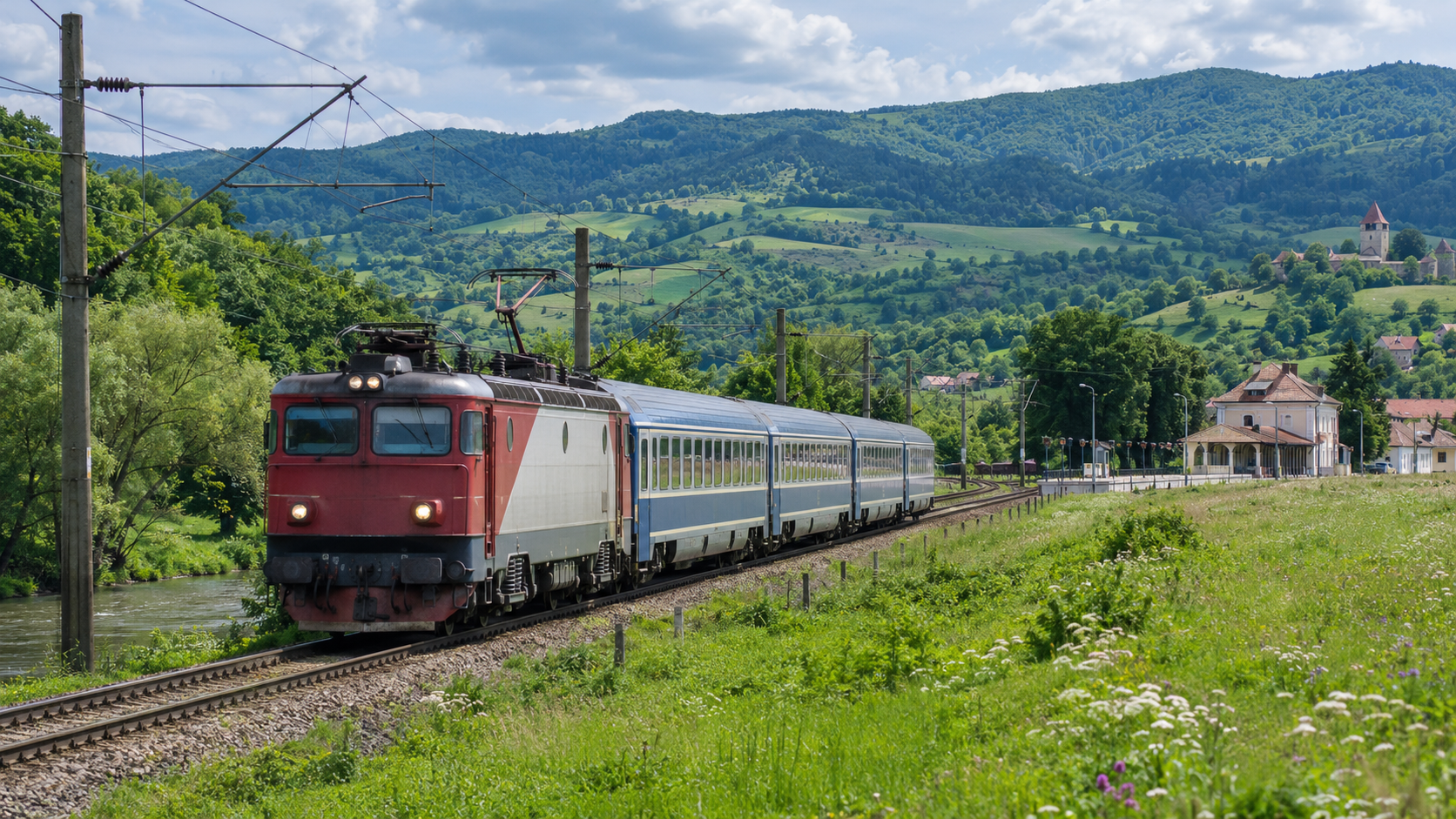
There is a useful restraint built into a rail trip: the line gives the journey a shape. For a first visit to Transylvania, use that shape to connect three different urban experiences. Brașov has mountains pressed close behind its old center; Sighișoara rises in a compact citadel; Sibiu opens into broad squares and a web of lower-town streets. They share elements of Saxon history, yet each deserves its own chapter.
This is a route for travelers who enjoy walking, architecture, and unhurried arrivals. Think in overnight stays rather than a race between stations. A useful starting allocation is two nights in Brașov, one in Sighișoara, and two in Sibiu. Add a night wherever you want a museum day, a regional excursion, or simply a morning without luggage.
A sequence, not a single through-train
Brașov and Sighișoara sit on a major rail corridor across Transylvania. Sibiu is a different branch of the journey, so compare the available Sighișoara-to-Sibiu options before fixing your accommodation. A direct service may suit your date; another departure may involve a change around a junction such as Copșa Mică. Search the complete journey with the actual railway operator and read the transfer details, rather than assuming that a line on a map means one continuous train.
Keep the travel day modest. An arrival afternoon is useful for finding your accommodation and taking a first walk, but it is a poor place for a tightly timed museum reservation. Do not attach an important flight to the end of a long cross-country rail leg. If the wider trip begins in the capital, our two-day Bucharest plan gives that arrival its own rhythm before the journey north.
Brașov: use the first day to get your bearings
Begin at Piața Sfatului, the Council Square, and let the streets around it explain the town's scale. The Black Church anchors one side of the historic center, while the slopes of Tâmpa make the city's setting apparent even before you climb anywhere. You can spend a satisfying first afternoon moving between the square, the older streets, and the line of the former defenses without turning the visit into a collection of admissions.
Give the second day a deliberate choice. Stay within Brașov for more time around the old center and the Schei district, or use it for a regional outing. Those are different visits. A day spent connecting fortified churches should not also carry an ambitious mountain walk. The Brașov and Saxon-town route concentrates on the surrounding heritage landscape; the Carpathian walking guide helps decide whether mountains deserve a separate base.
The railway station is outside the postcard center. Choose accommodation with the complete arrival in mind: luggage, local transport, and the walk to the door. A room on an atmospheric old street may be worth that final transfer, but knowing it is there makes the arrival calmer.
Sighișoara: make the overnight count
Sighișoara is the place where a one-night stay can change the experience most clearly. The historic center occupies a hill above the lower town, so the compact plan includes slopes, steps, and cobbles. Pack so that you can manage the last stretch to your accommodation, or choose a lower-town address if hauling a case uphill would outweigh the pleasure of staying inside the citadel.
Start with the Clock Tower area and the small streets inside the defenses. Then take the covered Scholars' Stairway toward the Church on the Hill if the route suits your mobility. The interest lies in the relationship between houses, lanes, gates, and the rising ground, not only in the view from a tower. Sighișoara's Saxon craftsmen and merchants helped shape a fortified town whose commercial and defensive roles can still be read in its layout.
Keep the evening and following morning free for a second circuit. A street you crossed while looking for a room often becomes more interesting when you return without bags. If you have only an afternoon between trains, concentrate on the lower town and one coherent citadel walk instead of trying to add a distant village.
Sibiu: end with space and choice
Sibiu rewards a longer final stay because it supports several different kinds of day. For the first, keep to the linked spaces of Piața Mare, Piața Mică, and the streets around the Lutheran cathedral. Look at how passages and stairways connect the upper and lower town. The change in level gives the center a different texture from Sighișoara's compact hilltop enclosure.
On a second day, decide between a museum-focused visit and a slower exploration beyond the main squares. The ASTRA open-air museum, outside the old center, merits a separate block of time rather than a hurried add-on. If you prefer art and interiors, build the day around one collection and leave the rest of the afternoon for the town. This is also a useful place to stop moving: a final full day without a transfer can make the whole route feel less fragmented.
Make rail travel the right choice
The train works well when the cities themselves are the main subject. It is less convenient for a string of dispersed villages, where the final connection matters as much as the intercity leg. Resist renting a car for every day simply because one side trip is awkward. You can keep the main route on rail and arrange a limited regional outing only where it improves the visit.
Travel light enough to handle station stairs and an uneven old-town approach. Keep food, water, a layer, and your booking information accessible rather than buried in a case. In winter, give yourself more margin for short daylight and slippery paving. In warmer months, avoid assuming that every train will have the same onboard facilities.
If time is short, reduce the number of cities before reducing every stay. Brașov plus Sighișoara gives a compact contrast; Brașov plus Sibiu allows two fuller urban bases. Keep all three when you can give each a distinct purpose. The route works because the stops differ, and because the hours between them are allowed to remain part of the journey.