
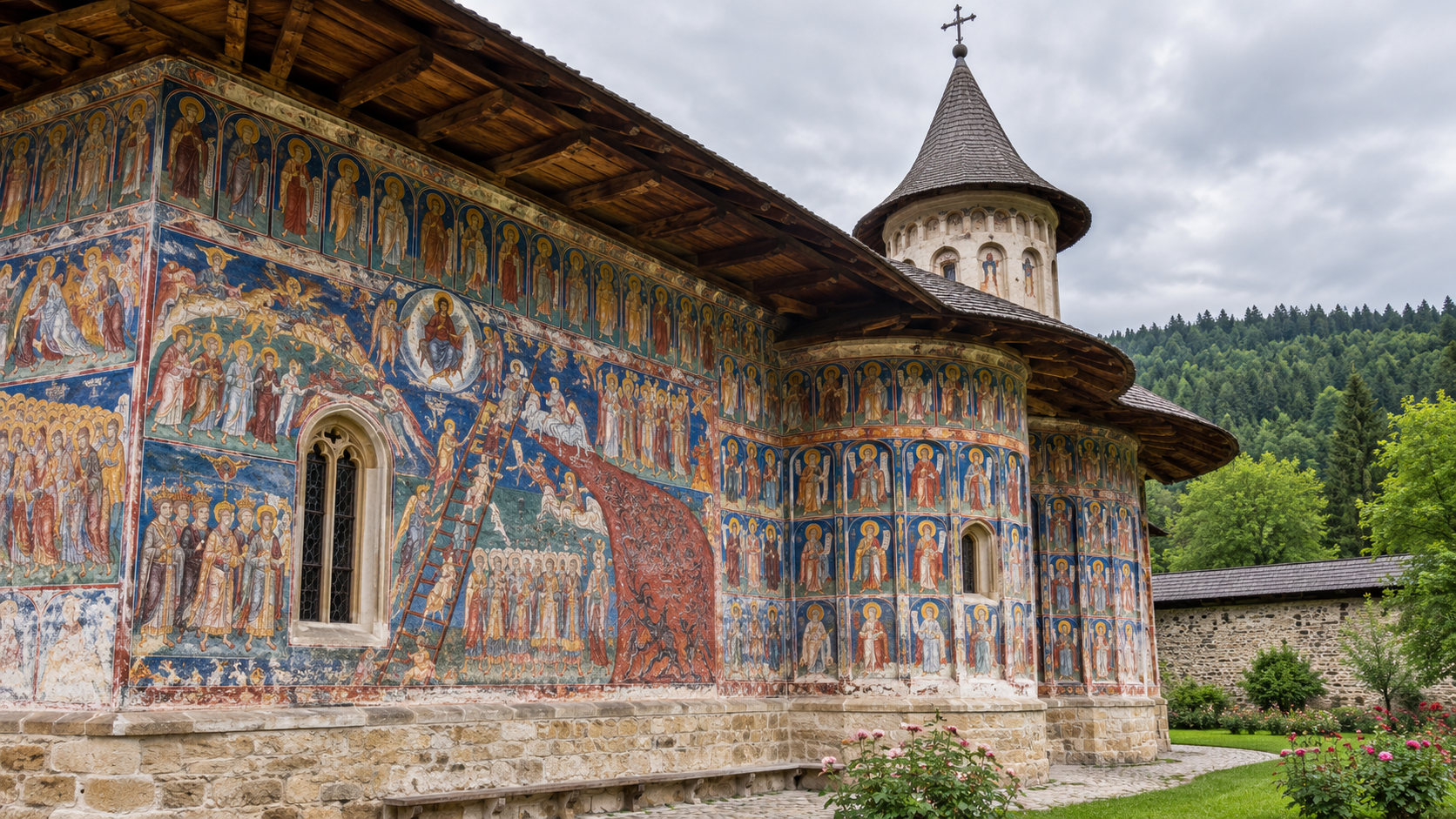
Bucovina's painted churches ask for a way of looking that is different from a rapid museum visit. Their exterior walls carry religious narratives into the open air, where figures, color, rooflines, and the surrounding landscape become part of one composition. You can recognize the subject from a photograph, but the scale of the paintings only becomes clear when you stand back, move closer, and follow the wall around a corner.
The most satisfying route is selective. Choose a few churches with contrasting settings and give each enough time for both the exterior and the interior. A two-day visit is a useful framework for a first encounter; a third day allows a quieter pace and a wider circuit. Trying to collect every famous name in one day can leave the paintings as a blur of blue, red, and gold.
Choose a base before drawing the circuit
Suceava and Gura Humorului are useful starting points for different versions of the trip. Suceava suits an arrival organized around a larger transport hub; Gura Humorului places you closer to a compact first circuit around Voroneț and Humor. Neither base removes the need to plan the last stretch to each monastery. The sites are spread through towns, villages, and hills, rather than lined up along a single walkable museum quarter.
A car or a carefully arranged local excursion can make a broader circuit practical. Public transport can suit individual visits, but it requires attention to the actual stop and return connection. Do not mistake the existence of a railway station in a nearby town for a direct connection to every church. If traveling without a car, a shorter route with time at two sites can be better than a day dominated by transfers.
First day: Voroneț and Humor
Begin with Voroneț, near Gura Humorului, if you want a strong introduction to the visual language of the region. Its exterior Last Judgment and famous blue tones give the eye an immediate focus. Start far enough back to understand the whole wall, then move in to follow one sequence of figures. Even without identifying every scene, you can notice hierarchy, gesture, and the way the composition directs attention.
Humor provides a useful second encounter because the building's scale and the character of its decoration feel different. The value of visiting both lies in comparison: how the paintings sit beneath the eaves, how the body of the church occupies the enclosure, and how a dominant color changes the experience of a wall.
Keep a pause between the two visits. The churches are active religious places, and concentration fades when one enclosure immediately follows another. A meal or a walk on public village streets gives your attention time to reset. The first day should leave you with details you can recall, not merely two additional photographs.
Second day: Moldovița and Sucevița
Use a second day for a broader route through the hills toward Moldovița and Sucevița. Plan the road journey as part of the day, with room to stop safely and take in the changing landscape. The route is less satisfying when every bend is viewed as lost time between admissions.
At Moldovița, look for the relationship between a large narrative scene and the smaller registers around it. At Sucevița, the enclosure and the scale of the complex offer a different first impression. Its depiction of the Ladder to Paradise is a strong place to begin looking, but stay long enough to see how the surrounding imagery expands the story beyond one famous scene.
This pairing works as a suggested circuit when local transport or an arranged outing makes the sequence sensible. If the connection is awkward, give one monastery the day and keep the other for a longer visit. Depth is a legitimate choice here.
Read the paintings without turning them into a quiz
The exterior frescoes belong to Orthodox Christian visual traditions, and their meaning is enriched by historical and religious context. The UNESCO-listed Churches of Moldavia recognize the importance of this wider group, not just the fame of one image. A knowledgeable local guide can help explain a scene, but you do not need to master an entire iconographic system before visiting.
Choose a small number of questions. Where is the main story placed? How do the figures relate to the architecture? Which surfaces are protected by the roof, and which have weathered more visibly? Why does a wall read differently in flat light than in sun? These questions make looking active without reducing the visit to memorizing names.
Avoid judging the whole church by the condition of one exterior side. Weathering, restoration, and the orientation of the building affect what remains visible. The interior, where permitted, offers another scale of space and light. Move between the two thoughtfully rather than assuming the exterior has already told the complete story.
Visiting a working religious place
Dress and behave with the setting in mind. Follow posted guidance on clothing, photography, and areas reserved for religious life. A quiet courtyard is not an invitation to move wherever a camera angle suggests. Ask before photographing people, and let worship take precedence over sightseeing.
Allow time to enter and leave without pressure. If a service changes access or an area is closed, use the opportunity to look at the building from another permitted position. A respectful visit is still worthwhile when it does not include every view you hoped to obtain. Access and photography arrangements should be confirmed at the site, rather than assumed from older travel accounts.
Build a route you can remember
For a first short visit, Voroneț and Humor make a focused introduction. Add Moldovița and Sucevița when you have the transport and time for a second day. With longer, choose another church such as Arbore for a distinct encounter rather than adding it only to complete a list.
Bucovina can follow a city-focused trip, but it deserves its own travel chapter. The Transylvanian rail route is organized around urban bases; this region works through a more dispersed landscape. If the trip also includes Carpathian walking, keep the mountain and monastery days separate enough that neither becomes a hurried stop on the way to the other.
The best souvenir of the route may be a single remembered detail: a gesture on a wall, the shadow of an eave, or the way a painted surface changes as you step back. Give the visit enough space for that kind of memory to form.