
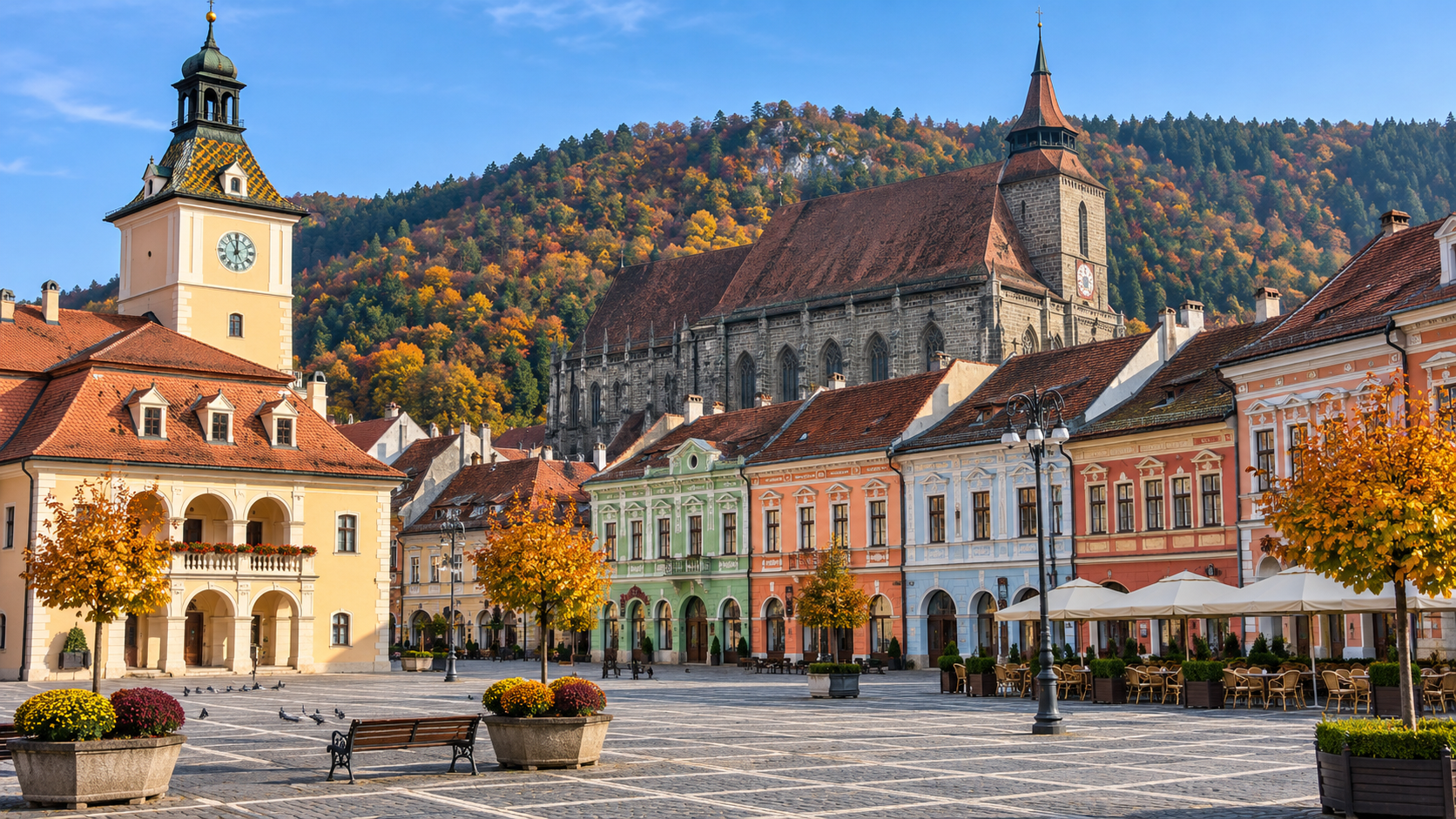
Brașov is an effective beginning for a journey through Transylvania's Saxon heritage because the town makes several themes visible at once. Trade and civic life meet in Council Square, religious history anchors the Black Church, and the older streets still relate to defensive edges and the rising land behind them. From that urban setting, nearby fortified churches offer a useful change of scale.
The most coherent short route begins with a full day in Brașov, then devotes a second day to Hărman and Prejmer if transport and access suit your dates. With more time, move onward toward Sighișoara and choose a village stop such as Viscri or Saschiz as a separate part of the journey. This keeps each place attached to a reason for visiting.
First understand the town
Start at Piața Sfatului, where the open square makes the surrounding street pattern easy to grasp. The Black Church is a strong next focus, but the route should include more than the most recognizable building. Walk toward the older defensive edge and notice how the streets narrow, turn, and meet the slopes. The relationship between built space and the surrounding terrain is part of the town's history.
Then leave room for the Schei district, with its own Romanian cultural and religious associations. This matters because a Saxon-history route should not flatten Transylvania into one community's story. The region's towns have been shaped by overlapping languages, faiths, political systems, and migrations. Looking at the difference between adjacent districts is more revealing than treating the whole center as one uniform medieval scene.
A full first day also makes the regional outing more meaningful. You will recognize how the defensive logic of a town differs from the concentrated enclosure around a village church. If Brașov is part of a longer car-free trip, the Transylvanian rail guide places it within a three-city sequence.
Hărman and Prejmer: make a focused comparison
Hărman and Prejmer lie beyond Brașov in the wider Bârsa region. Both are associated with fortified churches, but visiting them is most worthwhile when you look for differences rather than repeat the same photograph. Observe the position of the church, the form of its surrounding defenses, and the spaces that connect the religious building with the needs of the wider community.
At Prejmer, the enclosure makes the protective role especially clear. The rooms and storage spaces arranged within the fortification help explain how the site served more than worship alone. This is the useful question to carry through the day: how did a community organize the necessities of life when the church compound also had to offer refuge?
At Hărman, let the layout and surviving details establish a second example rather than expecting an identical experience. Walk slowly enough to understand the sequence of gates, walls, and church. A regional guide can add context, but the buildings themselves reward careful attention to how people moved through them.
Two sites are enough for a substantial day when you allow for travel, a meal, and time to look. Adding another distant stop often reduces the visit to entry, photograph, departure. If only one church is accessible during your dates, concentrate on it and return to Brașov for an unhurried evening.
The transport decision belongs to the route
A car can simplify a dispersed heritage day, while public transport may suit a focused visit when the stops and return connections work. Check the last stretch from the station or bus stop, not only the connection from Brașov. A short line on a map can conceal an awkward walk along a road or a long wait for the return.
You do not need a vehicle for every day of a city-based holiday simply because one outing is easier by road. Keep the urban days on foot and use a limited regional arrangement where it adds value. If hiring a guide or driver, agree on the pace, included stops, and return arrangement before the day begins. Choose an arrangement that gives you enough time at the sites to understand what you see.
When to extend toward Viscri or Saschiz
Viscri and Saschiz belong to a wider Transylvanian route rather than the compact two-church outing near Brașov. They can fit a journey toward Sighișoara, but each needs deliberate transport planning. Choose one when it complements the onward route and your interest in village life or church architecture; do not add both solely because their names appear together on heritage lists.
Viscri rewards attention to the relationship between houses, lanes, and the fortified church. Saschiz offers another form of church defense in a different settlement setting. Both are among the villages represented in the UNESCO property for fortified churches in Transylvania, whose importance lies in the connection between community, settlement, and religious architecture.
Remember that these are inhabited places. Keep to public ways, avoid blocking access with a car, and ask before photographing residents closely. A meal or overnight stay can deepen the visit when it is arranged thoughtfully and suits the actual route. Let the pace of the settlement guide your behavior rather than expecting every street to serve a visitor's schedule.
Separate heritage days from mountain days
Brașov's setting makes it tempting to attach a mountain walk to every itinerary. Give the two experiences separate days. A morning in a fortified church and an ambitious afternoon ascent usually leave too little margin for transport, weather, and fatigue. The Carpathian base guide helps decide whether walking deserves an additional night.
The same principle applies to other regions. Bucovina's painted monasteries tell a different story through exterior religious art. Comparing them with Transylvania's fortified churches can enrich a longer Romanian trip, provided each region has time to establish its own context.
A route with a clear stopping point
For two days, keep the plan to Brașov plus Hărman and Prejmer. For three or four, add a night in the Sighișoara area and one selected village stop along a sensible onward route. Confirm site access close to the visit, then let the day remain flexible enough for a longer conversation, a slower walk, or a quiet courtyard.
You will leave with a clearer understanding if you can explain how one enclosure differs from another than if you can list a dozen churches visited in haste. Start with the town, move into the surrounding settlements, and let each change of scale tell its part of the story.