
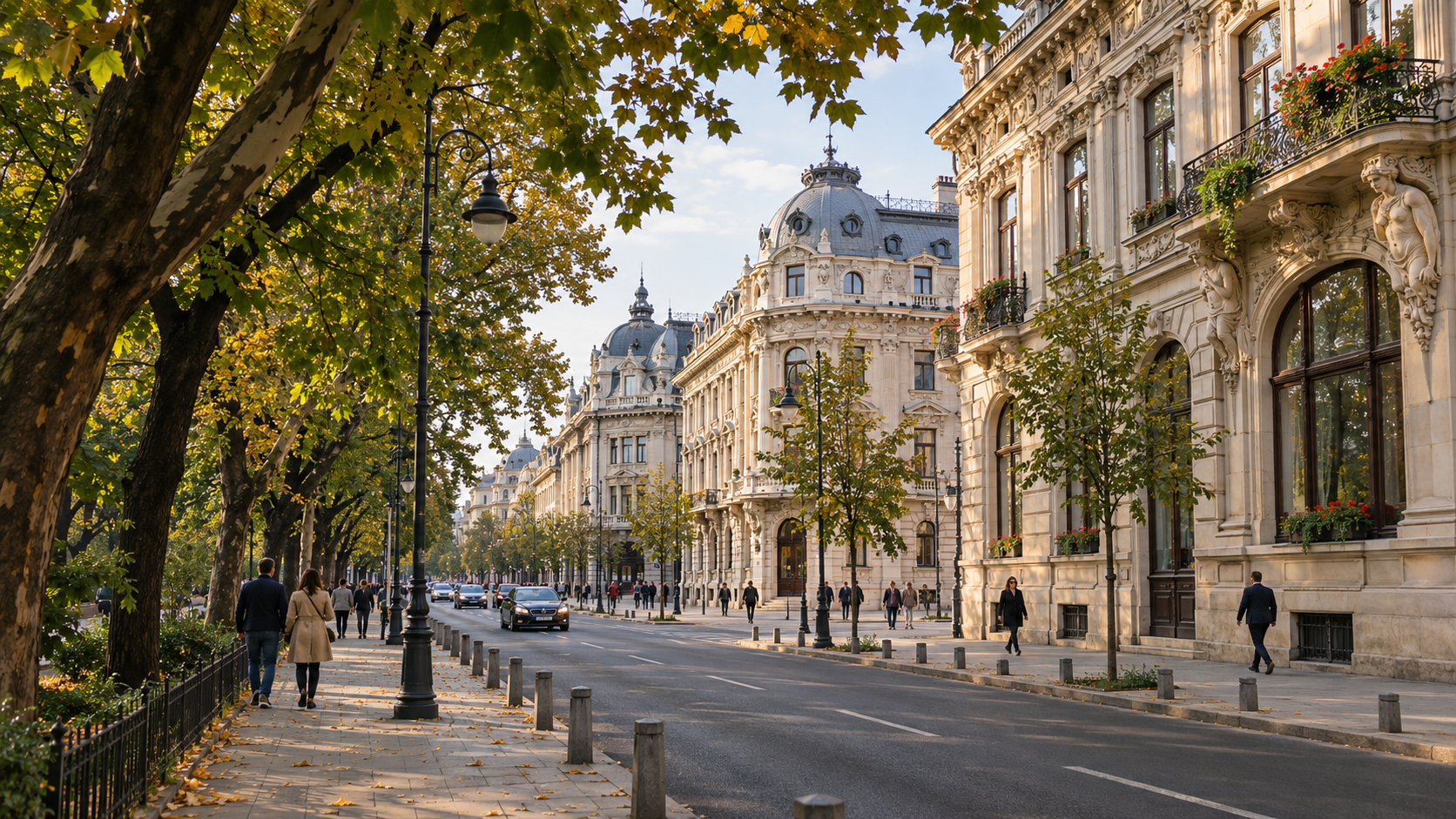
A first visit to Bucharest can feel disjointed if it is planned as a list of unrelated monuments. The distances expand, a grand avenue gives way to a quiet residential street, and an immense state building can sit close to a church on a much smaller scale. The way to make sense of the city is to choose a few connected areas and walk them with one clear question in mind: what does this part of Bucharest reveal?
For two days, give the first to the historic center and Calea Victoriei. Give the second a different texture, choosing between a neighborhood walk and a park-and-museum day. Giving each day a distinct focus makes the city easier to understand and leaves room for the details between landmarks.
First morning: begin at the smaller scale
Start in the old center around the streets near Stavropoleos Church. The church's modest courtyard and carved detail offer a useful counterpoint to the larger urban scenes that follow. Move through the surrounding lanes with room to notice passages, courtyards, and the mix of restored and weathered facades. This is a living entertainment district as well as a historic one, so its atmosphere changes through the day.
Keep the morning walk compact. The aim is not to cross every street carrying a tourist sign. Pause at the edge of a square, look above shopfront level, and notice where the older street pattern opens into a broad road. A coffee break is part of the route: it lets you see how people use a space rather than only photograph the buildings around it.
If you want a museum visit, choose one here and leave time for it. Do not put several major interiors before lunch and still expect an unhurried walk up the avenue. A common planning mistake in Bucharest is treating each marked attraction as a quick stop.
First afternoon: follow Calea Victoriei north
Calea Victoriei gives the afternoon a clear line. Walking north from the old-center end brings a sequence of civic, cultural, and commercial buildings into one legible route. Around Revolution Square, the city opens out; farther along, the Romanian Athenaeum gives the avenue another strong visual anchor. You do not need to enter every building to understand why this corridor matters.
Use the avenue as a spine, then make short detours into adjoining streets. This balance is more rewarding than following the busiest pavement without a pause. If a museum is the day's priority, let it determine where you stop; if architecture is the focus, keep moving slowly and save the interiors for another visit.
End the day when your attention starts to fade. Bucharest is not improved by a final cross-city dash simply to add one more name. Dinner near your accommodation can be more useful than another long transfer, particularly before a second day on foot.
Second day, option one: Cotroceni
Choose Cotroceni if you want the second day to feel different from the first. Its residential streets shift attention from monumental facades to houses, gardens, and the relationship between a building and its street. This is a good area for a deliberately loose walk, with the understanding that homes are private and that a quiet neighborhood should be treated with corresponding care.
A visit to the Cotroceni museum complex is a separate decision from walking the district. If an interior is important, check its current reservation and identification arrangements before building the day around it. Otherwise, make the neighborhood itself the subject and leave the afternoon flexible for a return to the center.
This option suits travelers who like architecture at street level and do not want two consecutive days of major attractions. It also works after an evening arrival, when a slower second morning may be more appealing than another early admission.
Second day, option two: a park and an open-air museum
For a greener contrast, head north toward the park around Lake Herăstrău, officially part of King Michael I Park. Pair a walk there with the Dimitrie Gusti National Village Museum if its collections interest you. The museum brings buildings and rural material culture into an outdoor setting; it offers a useful change of scale after the capital's broad avenues.
Keep this as one part of the city rather than combining it with Cotroceni and every remaining central landmark. An open-air collection takes time to absorb, and a park is most pleasant when it is not merely a corridor to the next appointment. In wet or very cold weather, a single indoor museum can replace the whole plan without weakening the trip.
Where the Palace of Parliament fits
The Palace of Parliament is a major landmark, but it changes the shape of a short visit. Its vast scale and the surrounding roads ask for a deliberate approach. Seeing the exterior can be part of an architectural day; an interior visit requires current booking information and a dedicated block of time. Do not assume you can arrive casually between two other activities.
If the building is a priority, replace part of the first afternoon rather than adding it to an already full route. A focused visit leaves room to consider the scale of the redevelopment around it. That is more meaningful than treating the building as a brief photo stop detached from its surroundings.
Make the two days comfortable
Choose accommodation for access to the areas you want to explore, and think about the actual walk from a transit stop to the door. The metro is useful for longer jumps, while walking explains the transitions between neighborhoods. Surface routes can be helpful too, but check the stop and direction before boarding. Keep shoes suited to uneven paving and carry a layer that matches the season.
In summer, move the longest exposed walks toward the cooler parts of the day. In winter, put a warm indoor stop between outdoor sections instead of expecting one uninterrupted circuit. Two days are enough for a coherent introduction when each has a distinct purpose: first the historic and civic spine, then a neighborhood or green-space contrast.
If your journey continues north, use the capital as the first chapter of a Transylvanian rail route. If you are comparing city time with a landscape-focused trip, the Danube Delta guide shows how different Romania can feel when movement is organized around water rather than streets.