
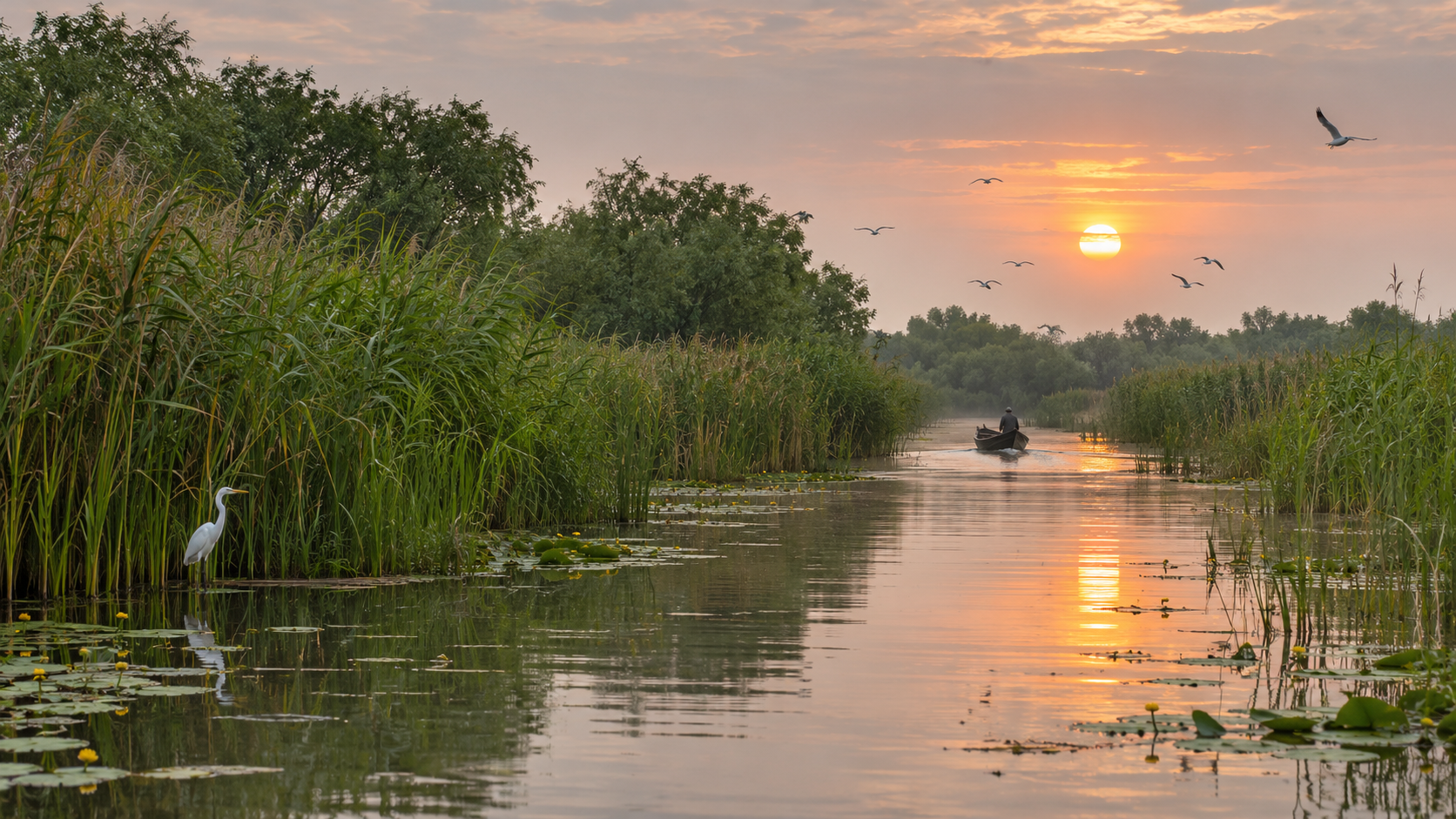
The Danube Delta asks you to change the way you measure a trip. A road itinerary counts towns and miles; here the useful units are channels, boat departures, quiet observation, and time spent in one place. The landscape includes reed beds, lakes, branches of the river, and settlements with their own everyday routines. Wildlife is part of that landscape, but so are work, transport, and the homes along the water.
A rewarding first visit begins by choosing a base and a style of travel. Do you want to remain near a road connection and take boat outings, or stay deeper in the Delta and let water transport shape the whole visit? Answering that question does more for the trip than trying to cover the largest possible area.
Begin with Tulcea, then choose your direction
Tulcea is the principal gateway for many visitors. Treat it as a place to organize the onward journey rather than assuming that arrival there means you have reached your final base. The Delta's main branches lead toward different settlements, and the boat that suits one route may be irrelevant to another. Confirm both the outward and return arrangements before committing to accommodation reached primarily by water.
A short stay near the western edge can suit someone who wants a first look without building the entire holiday around boats. A longer stay farther inside the Delta suits travelers who welcome fewer immediate choices and more time on the same stretch of water. The right choice depends on the pace and practical constraints of your trip.
Leave margin between a boat transfer and a long onward journey. Wind, water conditions, and operating changes can alter a day's movement. A flexible final night gives the journey more resilience than an increasingly precise chain of connections.
What a village base changes
Settlements such as Crișan, Sulina, and Sfântu Gheorghe offer different relationships to the water. Crișan is associated with the Sulina branch and a network of channels; Sulina has the feel of a small river town near the sea; Sfântu Gheorghe sits by another river mouth and has a different sense of distance. Choose one as a base rather than assuming they form a quick daily circuit.
Look closely at the accommodation's location, meal arrangements, and transfer information. A place described as being in the Delta may be on a road-accessible edge or may require a specific boat journey. That distinction affects luggage, arrival time, and how independently you can move. If you want to walk to dinner, be sure the address actually supports that kind of evening.
Staying several nights in the same place allows a quieter day between outings. You can observe the riverfront, walk public village lanes, and see how the light and weather change a familiar view. Avoid treating private jetties, fishing equipment, or people's houses as scenery that can be entered without permission.
Choose an outing by its behavior
Before booking a boat excursion, ask what kind of craft is used, how many people it carries, and whether the pace allows observation. A birdwatching outing and a fast transfer serve different purposes. An operator who explains route limits and wildlife distance is giving useful information. Choose an outing with a clear account of what it can offer, rather than one promising close encounters with every notable species.
Keep the boat's noise and wake in mind as well as the view. Quiet movement and space around wildlife matter in a breeding and feeding landscape. Do not ask a guide to approach a colony for a better photograph. Binoculars let you see more while remaining farther away, and a patient look often reveals details that a rapid circuit misses.
The Delta is recognized by UNESCO for its natural importance. That recognition is a reason to travel carefully, but access still depends on the rules for each area. Use authorized routes and confirm current reserve permits, access restrictions, and local travel advice before setting out. Some areas have different rules from the route used to reach your accommodation.
Give the day a quiet center
An early outing can provide good light and a calmer start, but the day does not need to become one long boat session. Return for a meal and a rest, then decide whether another short trip adds something distinct. A lake, a narrow reed channel, and a village riverfront are different experiences; seeing each slowly can be more memorable than repeating a larger circuit.
Carry drinking water, sun protection, a layer for wind, and whatever personal supplies you need for the outing. Insects can affect comfort, especially around still water and in warmer weather. Keep a bag that protects valuables from spray and rain without requiring you to unpack everything at each stop. Ask about life jackets and the practical arrangements before boarding.
Food is another reason to understand your base. Fish is important in many local menus, but do not assume every meal or dietary need can be improvised in a small settlement. Discuss meals ahead of time, and treat local cooking as part of the visit rather than a performance arranged for a visitor.
Season changes the subject
The Delta does not offer the same experience throughout the year. Bird movement, vegetation, heat, daylight, and the availability of visitor services all shift. Spring and autumn may appeal to travelers interested in migration and seasonal change; summer brings long days but also heat and a busier visitor rhythm. A winter visit asks for more deliberate arrangements.
Choose the season for the experience you want, then ask a knowledgeable local operator what is realistic during your dates. Avoid arriving with a rigid species list or expecting a photograph to be repeatable. The landscape is dynamic, and wildlife is never scheduled for a visitor's convenience.
How much of a Romania trip belongs here?
Give the Delta its own block of time rather than attaching it as an afterthought to a mountain circuit. The contrast with Bucharest's neighborhoods or a Transylvanian rail journey can be the point of the holiday, provided the transfer between those chapters is allowed a full place in the plan.
For a short visit, choose one base and one well-considered outing. For a longer stay, deepen the experience through different times of day and a second kind of route rather than continually changing accommodation. The Delta rewards attention more reliably than coverage: one quiet channel observed well can tell you more than a day spent rushing toward the next one.